
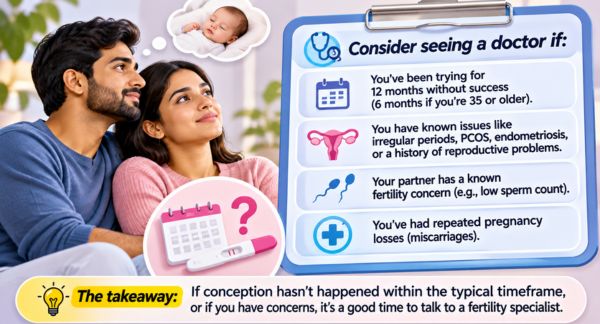
You should consider medical help for delayed conception after 12 months of regular unprotected intercourse if you are under 35, or after 6 months if you are 35 or older. Women over 40 may benefit from an earlier fertility evaluation. You should also seek help sooner if you have irregular periods, suspected PCOS, endometriosis, previous pelvic surgery, recurrent pregnancy loss or another known fertility concern. A gynecologist can begin the evaluation and guide you towards fertility care when needed.
When Waiting Starts to Feel Different
Trying to conceive often begins without much planning. You may simply stop using contraception and expect pregnancy to happen in the next few months. When it does not, you might tell yourself that it is still early and keep trying.
Then another month passes. For some couples, this waiting period is manageable. For others, every period brings another round of disappointment and questions. You may start wondering whether something is wrong, whether you should have seen a doctor earlier, or whether you simply need to keep trying.
There is no need to panic if pregnancy has not happened immediately. It can take time even when there is no fertility problem. But there is also a point when getting medical advice makes sense.
The timing depends partly on your age and partly on your health history. Current ASRM guidance recommends fertility evaluation after 12 months of trying for women under 35 and after 6 months for women aged 35 or older. For women over 40, more immediate evaluation may be appropriate. You may also need to seek help earlier if you already know that something could affect fertility.
You Do Not Always Have to Wait 12 Months
The one year rule is not meant for everyone. If your periods are very irregular or absent, waiting for 12 months may not give you useful information. Irregular cycles can indicate that ovulation is not happening regularly, and ASRM recommends starting evaluation without delay when a known condition is associated with infertility.
The same applies if you have been diagnosed with endometriosis, have had certain pelvic surgeries, have a history of recurrent pregnancy loss, or have reason to suspect a problem with your fallopian tubes.
Male fertility concerns are another reason not to wait. If your partner has had testicular surgery, significant reproductive health problems or a previous abnormal semen analysis, it can make sense to assess both partners earlier.
The idea is simple. If there is already a reason to suspect a fertility problem, waiting for an arbitrary number of months may not help.
Age Changes the Timing
Age is one of the biggest factors in deciding when to seek fertility advice. If you are under 35 and have regular unprotected intercourse without pregnancy, an evaluation is generally recommended after 12 months. Once you reach 35, the recommended waiting period becomes shorter. At 40 and above, fertility evaluation may be appropriate much sooner.
This does not mean that pregnancy suddenly becomes impossible at 35 or 40. Fertility changes gradually, and every woman’s situation is different. The reason doctors pay attention to age is that egg quantity and quality decline over time. Waiting longer can reduce the time available to investigate a problem and consider treatment options if you need them.
If you are 35 or older and have already been trying for several months, talking to a doctor can give you a clearer idea of whether it is worth continuing to try naturally or whether an evaluation would be useful.
Some Signs Deserve Earlier Attention
You do not need to wait for a full year if your body is already giving you clues that something may need checking. Irregular or very long cycles are one example. Periods that disappear for several months also deserve attention. Painful periods can be another reason to speak with a doctor, particularly if the pain affects your daily life or raises concern about endometriosis.
Other things worth mentioning during an appointment include unusual bleeding between periods, a history of pelvic infection, previous surgery involving the reproductive organs, or previous treatment that may have affected fertility.
You may also want to seek advice if you have symptoms associated with hormonal problems, such as excessive facial hair, significant acne, unexplained changes in weight or symptoms suggesting thyroid problems. None of these symptoms automatically means that you are infertile. They simply give your doctor a reason to look more closely.
What Can a Gynecologist Do First?
If you are unsure where to begin, seeing a gynecologist in chennai can be a reasonable first step. Your appointment may begin with questions rather than tests. Your doctor may ask about your menstrual cycles, how long you have been trying to conceive, previous pregnancies, miscarriages, surgeries, medical conditions and medicines.
Your partner’s fertility history may also come into the conversation. ASRM recommends a comprehensive medical, reproductive and family history as part of the initial fertility evaluation. When a male partner is contributing sperm, evaluation of both partners should begin at the same time, including a semen analysis where appropriate.
Depending on what your history shows, your doctor may recommend an ultrasound, blood tests, ovarian reserve assessment or testing of the fallopian tubes. Not everyone needs every fertility test. The evaluation should be guided by your symptoms and medical history. A gynecologist can also recognise when your situation needs more specialised fertility care and refer you when appropriate.
Regular Periods Do Not Answer Every Fertility Question
Having a period every month can be reassuring, but it does not answer every question about fertility. For many women with regular cycles, ovulation is likely to be occurring. However, other factors can still affect conception. The fallopian tubes need to be open, the uterus needs to be suitable for pregnancy and sperm health also matters.
ASRM notes that ovulatory function, the structure and patency of the female reproductive tract and semen evaluation are all parts of a fertility assessment. This is why you should not assume that delayed conception is caused by something you are doing wrong. Fertility can involve several factors, and sometimes no single cause is found.
If your periods are regular but pregnancy has not happened within the recommended timeframe, an assessment can help determine what is worth checking.
PCOS and Endometriosis Need Their Own Conversation
Some conditions deserve particular attention because they can affect fertility. PCOS can interfere with ovulation, although the symptoms and severity vary between women. Some women have irregular periods, while others may have relatively predictable cycles but other signs of PCOS.
Endometriosis can also affect fertility. Some women have painful periods or pelvic pain, while others have few obvious symptoms. A known or suspected history of endometriosis is one of the situations where fertility evaluation may be appropriate without waiting for the usual 12 month period.
If you already have one of these conditions and pregnancy is your goal, a preconception or fertility consultation can help you understand whether anything needs attention before you spend months trying without a plan.
Both Partners Should Be Part of the Assessment
It is easy for fertility discussions to focus almost entirely on the woman. That can delay useful information. Male factors can contribute to difficulty conceiving, and ASRM recommends evaluating both partners at the beginning of an infertility assessment when applicable. A semen analysis is one of the basic ways to look at sperm health.
This does not mean that anyone is being blamed. Fertility is a shared process, and looking at both partners can prevent unnecessary delays. If your partner has previous semen analysis results, bring them to the appointment. If there has never been an assessment, ask whether one would be appropriate.
What Happens During a Fertility Consultation?
Many people delay making an appointment because they assume it will immediately lead to treatment. It does not have to.
Your first appointment may simply be a conversation about what has been happening. Your doctor may review your cycle pattern, previous pregnancies, medical conditions and fertility history before deciding which investigations are useful.
A routine physical examination is not always necessary during an initial infertility evaluation. ASRM recommends targeted examination when the history or other findings indicate that it could provide useful information.
Testing may include ultrasound, blood work, ovarian reserve assessment or evaluation of the fallopian tubes depending on the circumstances. The aim is to find out what needs attention. Treatment comes after the evaluation, not automatically before it.
When Should You See a Fertility Specialist?
A gynecologist can be a useful starting point, but you may eventually need a fertility specialist. This can happen when the cause of infertility is complex, when assisted reproductive treatment may be appropriate, or when earlier treatment has not worked. ACOG notes that referral to a fertility specialist may be considered when the cause, treatment or previous treatment failures go beyond the expertise of the obstetrician gynecologist.
You do not need to wait until you have exhausted every option before asking about specialist care. If you are 35 or older, have a known fertility condition or have already undergone unsuccessful fertility treatment, discussing referral earlier may be sensible.
Choosing a Gynecologist in Chennai
If you are searching for the best gynecologist chennai, it is easy to focus on rankings and online reviews. Those can help you create a shortlist, but they cannot tell you how a doctor will approach your particular concerns.
Look for someone who gives you enough time to explain what has been happening. You should be able to discuss periods, previous pregnancies, pain, sexual health and fertility concerns without feeling uncomfortable or rushed.
If you are comparing a gynecologist hospital in chennai, consider whether the centre can support you if your evaluation leads to fertility treatment. Access to diagnostic services and fertility specialists can make the next steps simpler.
People searching for a best gynecologist doctor in chennai or good gynecologist in chennai may also want to consider communication and continuity of care. Fertility concerns can take more than one appointment to understand, so having a doctor you are comfortable returning to matters.
If pregnancy is your immediate goal, you may specifically search for the best gynecologist in chennai for pregnancy. If you have already been trying without success, the more relevant search may be the best gynecologist in chennai for infertility. The right choice depends on what you need from the appointment.
What Should You Take to Your Appointment?
You do not need a large folder of paperwork. If you have previous ultrasound reports, blood tests, semen analysis results or fertility treatment records, take them with you. Write down the medicines and supplements you currently use. It can also help to note your usual cycle length, the date your last period started and any symptoms that seem unusual. If you have been tracking ovulation, bring those records too.
Most importantly, think about what you want to ask. You might want to know whether your age changes when you should be evaluated, whether your cycle suggests an ovulation problem, whether your partner needs testing or whether you should see a fertility specialist. Having these questions ready can make the appointment much more useful.
You Do Not Need to Wait Until You Are Worried
There is a difference between seeking help and assuming something is wrong.
A fertility consultation does not mean you have been diagnosed with infertility. It can simply give you information about your reproductive health and help you decide whether you need to keep trying naturally, make a few changes or explore further testing.
If you are under 35 with no known fertility concerns, you may reasonably have more time before seeking an infertility evaluation. If you are 35 or older, the timeline becomes shorter. If you are over 40 or have a known condition that may affect fertility, earlier advice is sensible.
The important thing is not to let uncertainty keep you waiting when there is a clear reason to seek help.
Conclusion
Delayed conception does not automatically mean that something is wrong. Sometimes pregnancy simply takes longer than expected. But there are clear points when talking to a doctor becomes worthwhile.
For women under 35, fertility evaluation is generally recommended after 12 months of trying. From age 35, the recommended timeframe is around 6 months, while women over 40 may benefit from more immediate evaluation. Known concerns such as irregular periods, endometriosis, recurrent pregnancy loss or suspected male fertility problems are reasons to seek advice sooner.
A gynecologist in chennai can be a practical place to begin. Your doctor can review your reproductive history, identify concerns that need investigation and guide you towards fertility care if necessary.
At Shairaksha Fertility Centre, the aim is to help you understand what may be affecting conception and decide what to do next based on your individual situation.
If you have been trying to conceive and are unsure whether it is time to seek help, book a consultation with Shairaksha Fertility Centre and discuss your fertility concerns with a specialist.
Frequently Asked Questions
How long should I try naturally before seeing a doctor?
If you are under 35 and have regular unprotected intercourse without pregnancy, an infertility evaluation is generally recommended after 12 months. If you are 35 or older, evaluation is recommended after 6 months. Women over 40 may benefit from more immediate assessment.
Should I see a gynecologist if my periods are irregular?
Yes. Irregular or absent periods can indicate ovulation problems and are a reason to seek fertility advice without necessarily waiting for a full year.
Can a gynecologist check fertility?
A gynecologist can begin a fertility evaluation by reviewing your reproductive history, menstrual pattern and relevant medical concerns. Depending on the findings, they can recommend appropriate testing or refer you to a fertility specialist.
Should my partner also have a fertility assessment?
Yes, when a male partner is contributing sperm. Male factors can contribute to infertility, so evaluation of both partners is recommended rather than focusing only on the woman.
When should I see a doctor if I am over 40?
If you are over 40 and planning pregnancy, fertility evaluation can be considered before spending a long period trying naturally. ACOG recommends discussing evaluation with an obstetrician gynecologist at this age.
Does delayed conception always mean infertility?
No. Delayed conception can happen for many reasons, and sometimes no specific cause is identified. An evaluation can help determine whether there is a factor affecting fertility and whether treatment could help.
What should I take to my first fertility appointment?
Previous fertility reports, ultrasound scans, blood test results, semen analysis reports, medication details and information about your menstrual cycle can all be useful. A short list of questions can also help you make better use of the appointment.