
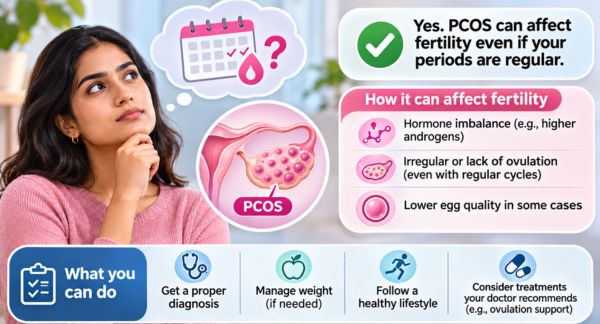
Yes, PCOS can affect fertility even when periods appear regular. Regular bleeding does not always confirm that ovulation is happening consistently. Some women with PCOS may have ovulatory problems despite having predictable cycles. A fertility assessment can look at ovulation, hormone levels, ovarian function and other factors to find out whether PCOS is affecting your chances of conception.
Regular Periods Do Not Tell the Whole Story
When your periods arrive around the same time every month, you may naturally assume that everything is working normally. That is often reassuring, especially when you are planning a pregnancy. But a regular period does not always confirm that ovulation has happened.
Ovulation is the release of an egg from the ovary. It is an important part of conception, and problems with ovulation can make pregnancy more difficult. The 2023 international PCOS guideline specifically notes that ovulatory dysfunction can still occur in women who have regular menstrual cycles. If there is a reason to suspect that ovulation is not happening, doctors can use further assessment, including serum progesterone testing when appropriate.
This can be confusing if you have been told that your periods look normal. You may have a predictable cycle and still have another PCOS feature that affects fertility.
That is why the question is not simply whether you get your period every month. It is whether you are ovulating regularly and whether PCOS is affecting the reproductive process in another way.
How Can PCOS Affect Fertility?
PCOS can affect fertility in several ways, although the experience is different for every woman. Ovulation problems are one of the main reasons. In PCOS, hormonal changes can interfere with the normal development and release of an egg. Some women may ovulate less often, while others may have cycles where ovulation does not happen.
There can also be other factors to consider. PCOS is associated with higher androgen levels and metabolic problems such as insulin resistance. These factors can be part of the wider picture when a woman is trying to conceive. ACOG notes that PCOS affects more than menstrual health and is also associated with metabolic and other long term health concerns.
Having PCOS does not mean that pregnancy will be difficult for everyone. Many women with PCOS become pregnant naturally, while others may need help with ovulation or fertility treatment. The international guideline also reassures women with PCOS that pregnancy can often be achieved naturally or with assistance.
You Can Have Regular Cycles and Still Need an Ovulation Check
This is one of the reasons fertility assessment can be useful. Suppose your periods arrive every 28 to 32 days, but you have been trying to conceive for several months without success. You may think there is no reason to investigate ovulation because your cycle looks regular.
Your doctor may still want to look more closely, particularly if you have other signs associated with PCOS. A history of acne, excess facial or body hair, difficulty with weight management or previous hormone concerns may give your doctor more information. A fertility assessment may also consider your age, how long you have been trying, previous pregnancies and your partner’s fertility.
If there is a concern about ovulation, your doctor may recommend appropriate testing. The aim is not to label every woman with regular periods as having an ovulation problem. It is to find out whether there is a reason conception has not happened as expected.
What Does a PCOS Fertility Assessment Look At?
There is no single test that can tell you whether PCOS is affecting your fertility. Your doctor may begin by asking about your periods, symptoms and medical history. Blood tests may be used to assess hormone levels, while ultrasound can provide information about the ovaries and uterus.
If your cycles are regular but ovulation is uncertain, your doctor may use additional testing to check whether ovulation is occurring. The 2023 PCOS guideline states that ovulatory dysfunction can occur even with regular cycles and that serum progesterone can be used when confirmation of anovulation is needed.
Your partner’s fertility should also be considered. A semen analysis may be recommended because conception can be affected by male fertility factors as well. This approach gives your fertility specialist a wider view of what may be happening instead of assuming that PCOS is automatically the only reason pregnancy has been delayed.
PCOS Does Not Mean You Need IVF
Finding out that you have PCOS does not automatically mean you need advanced fertility treatment.
If ovulation is the main problem and there are no other infertility factors, treatment may begin with ovulation induction. The 2023 international guideline recommends letrozole as the preferred first line medication for ovulation induction in women with PCOS who have anovulatory infertility and no other infertility factors.
The treatment plan can change depending on your response. Some women may ovulate with medication and try timed intercourse. If that does not work, other fertility treatments may be considered. IUI or IVF can become options when the situation calls for them or when other treatments have not been successful.
This is why a diagnosis alone should not determine your treatment. Your fertility history, age, ovulation pattern and other test results all matter.
Could PCOS Affect Egg Quality?
PCOS is often discussed in relation to ovulation, but women sometimes worry that the condition automatically means their eggs are poor quality. It is more complicated than that.
PCOS can result in a larger number of small follicles and disrupted ovulation. That does not mean that every woman with PCOS has poor egg quality. When fertility treatment is needed, your specialist will consider ovarian response and other factors rather than making assumptions based on the diagnosis alone.
Age remains an important factor in female fertility. Your doctor may also assess ovarian reserve when planning treatment, but tests such as AMH should not be treated as a simple measure of whether you can become pregnant. A fertility assessment looks at the complete picture.
What About Insulin Resistance?
Insulin resistance is common in PCOS and can be part of the wider metabolic picture. It can also be associated with higher androgen levels and other features of the condition. This does not mean that every woman with PCOS has insulin resistance. Your doctor may consider your medical history, symptoms and metabolic health before deciding whether further assessment is appropriate.
The 2023 international guideline recommends healthy lifestyle support throughout life for women with PCOS and emphasises prevention of weight gain and appropriate weight management when needed. It also recommends avoiding weight stigma during care.
If you are trying to conceive, this conversation should be about improving your overall health and fertility care rather than focusing only on a number on the weighing scale.
Lifestyle Can Be Part of Fertility Care
There is a lot of advice online about what women with PCOS should eat, avoid or take. Some of it can sound very certain, even when the evidence is not.
There is no single diet that has been shown to be the best choice for every woman with PCOS. The international guideline recommends healthy lifestyle practices but does not support one specific diet or exercise plan as being superior for all women.
Regular physical activity, balanced nutrition, adequate sleep and appropriate weight management can support overall health. If you have diabetes, high blood pressure or another health condition, managing it before pregnancy is also important.
You do not need to follow an extreme diet or make drastic changes because an online post told you that PCOS requires it. Discuss your individual needs with your doctor or a qualified healthcare professional.
When Should You Seek Fertility Advice?
You do not necessarily need to wait until your periods become irregular before speaking to a doctor. If you have known PCOS and are planning pregnancy, a preconception consultation can help you discuss your health and fertility goals. If you have been trying to conceive without success, your age and medical history can help determine when an evaluation is appropriate.
You may also want to seek advice sooner if you have had previous fertility problems, pregnancy loss or treatment that did not work. The point of an early consultation is not to push you into fertility treatment. It gives you a chance to find out whether ovulation is occurring and whether anything else needs attention.
Choosing Care for PCOS and Fertility
If you are searching for the best pcos treatment in chennai, it is worth looking beyond a clinic’s treatment list. Ask how the doctor approaches PCOS when pregnancy is the goal. Does the consultation include your menstrual history and fertility plans? Will ovulation be assessed when necessary? Can the team evaluate other fertility factors if pregnancy is taking longer than expected?
Someone searching for the best doctor for pcos in chennai may also want to know whether the doctor treats PCOS as a long term health condition rather than focusing only on periods or weight.
The same applies when looking for a pcos specialist in chennai or comparing a pcos clinic in chennai. Good care should give you an opportunity to discuss symptoms, fertility plans and other health concerns without feeling judged.
If fertility becomes the main concern, a best pcos doctor in chennai should also know when additional fertility assessment or specialist care may be useful.
What Treatment Could Help If PCOS Is Affecting Fertility?
Treatment depends on what your assessment finds. If you are not ovulating regularly and there are no other infertility factors, ovulation induction may be recommended. Letrozole is currently recommended as the first line pharmacological treatment for ovulation induction in women with PCOS and anovulatory infertility when no other infertility factors are present.
Other treatments may be considered depending on how you respond, your medical history and the presence of other fertility factors.
If ovulation treatment does not result in pregnancy, your fertility specialist may discuss IUI or IVF depending on your circumstances. The international guideline places IVF as an option when first or second line ovulation induction has failed in women with PCOS and anovulatory infertility, unless there is another reason to proceed to IVF earlier.
This does not mean that every woman with PCOS will move through every treatment stage. The pathway is individual.
What If Your Periods Are Regular but Pregnancy Is Not Happening?
This is where it can be helpful to step back from PCOS itself. If you have regular periods and have been trying to conceive without success, PCOS may or may not be the reason. Your doctor may look at ovulation, the fallopian tubes, sperm health, age and other reproductive factors.
There may be more than one factor involved. Sometimes no single cause is found. A fertility assessment can help separate these possibilities. It can also prevent you from spending months assuming that PCOS is responsible when another issue may need attention.
What You Can Ask at Your Appointment
A fertility consultation does not need to be complicated. You can ask whether your regular periods are enough to confirm ovulation, whether your symptoms fit with PCOS, whether hormone testing is appropriate and whether your ovarian function needs assessment.
If you are trying to conceive, ask whether your partner should have a semen analysis and whether there are any other tests you should consider before starting treatment.
You can also ask what treatment would be considered if ovulation is the main issue and what the next step would be if the first approach does not work. These questions can give you a much clearer idea of where you stand.
Conclusion
Having regular periods does not completely rule out PCOS related fertility problems. Ovulation can still be irregular even when menstrual cycles appear predictable, and other PCOS related factors may also need attention.
That does not mean you should assume PCOS is the reason you are having difficulty conceiving. A proper fertility assessment can look at ovulation, hormone levels, ovarian function, your reproductive history and your partner’s fertility before deciding what needs to happen next.
For some women, simple ovulation support may be enough. Others may need additional fertility treatment. The right approach depends on what the assessment actually shows.
If you have PCOS, regular periods and concerns about getting pregnant, Shairaksha Fertility Centre can help you look at the fertility side of your condition and discuss the options available for your situation.
If you are looking for the best pcos treatment in Chennai, book a consultation with Shairaksha Fertility Centre and discuss your fertility goals with a specialist.
Frequently Asked Questions
Can I have PCOS if my periods are regular?
Yes. Regular cycles do not completely rule out PCOS or ovulatory dysfunction. Some women with PCOS can have regular periods while still experiencing problems with ovulation.
Can PCOS affect fertility without irregular periods?
Yes. Ovulatory dysfunction can occur even when cycles appear regular. Other PCOS features may also be relevant when assessing fertility.
How can I find out if I am ovulating?
Your doctor may use your menstrual history, ultrasound or hormone testing depending on your situation. Serum progesterone can be used in some cases when ovulation needs to be confirmed.
Can women with PCOS get pregnant naturally?
Yes. Many women with PCOS become pregnant naturally, while others may need fertility assistance. The PCOS guideline recommends reassuring women that pregnancy can often be achieved with or without treatment.
What is the first fertility treatment for PCOS?
For women with PCOS who have infertility because they are not ovulating and have no other infertility factors, letrozole is recommended as the first line medication for ovulation induction.
Should I see a PCOS specialist if I am trying to conceive?
A consultation can be useful if you have PCOS and are planning pregnancy, particularly if you have concerns about ovulation or have been trying without success. Your doctor can decide whether fertility testing or treatment is appropriate.
Does PCOS mean I will need IVF?
No. IVF is not automatically required. Treatment depends on the cause of infertility and how you respond to earlier approaches. IVF may be considered when appropriate ovulation induction treatments have not worked or when another fertility factor makes IVF more suitable.