
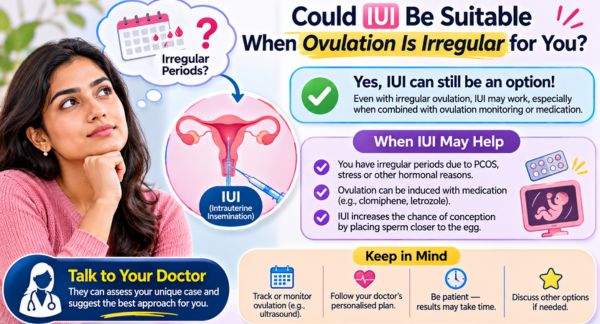
IUI may be suitable for some women with irregular ovulation when the cause of the problem can be treated and ovulation can be monitored or timed. Before recommending IUI, a fertility specialist may look at the menstrual pattern, ovarian function, fallopian tubes, sperm health, age and previous fertility history. Some women may need ovulation treatment first, while others may benefit from combining ovulation support with IUI.
When Your Cycle Keeps Changing
Trying to conceive can feel very different when you cannot predict your own cycle. You may have a period after 30 days one month and wait much longer the next time. You might use an app to track your dates, try an ovulation kit and still be unsure whether you have actually ovulated. When this happens month after month, it is easy to wonder whether you are simply missing the right days or whether something else is going on.
Irregular periods do not always mean that you are not ovulating. Some women with irregular cycles still release an egg, while others ovulate only occasionally. Very long cycles, missed periods or other changes can point towards an ovulation problem that needs to be checked. Current ASRM guidance recommends earlier fertility evaluation when irregular menstrual cycles are present rather than waiting for the usual timeframe used when there are no known fertility concerns.
There can be several reasons for irregular ovulation. PCOS is one of the better known causes, but thyroid problems, changes in weight, high prolactin levels, intense exercise and other hormonal issues can also affect the cycle.
So if you are considering iui fertility treatment in Chennai, irregular ovulation does not automatically take IUI off the table. The bigger question is whether ovulation can be supported or timed and whether IUI is actually useful for your overall fertility situation.
IUI Works Around the Time of Ovulation
The timing of IUI matters. During IUI, prepared sperm is placed inside the uterus around the time an egg is expected to be released. This gives the sperm a shorter route towards the fallopian tubes, where fertilisation normally takes place.
That timing can be easier when your cycle is regular. When your periods are unpredictable, your fertility team may need to monitor what is happening in your ovaries instead of relying only on calendar dates.
Ultrasound can be used to watch a follicle as it develops. Depending on the situation, medication may be used to help ovulation occur at a suitable time. ACOG explains that ovulation stimulation can be used when ovulation is irregular or absent and may be combined with IUI.
This is why IUI and ovulation treatment are sometimes discussed together. They are not doing the same job. Ovulation treatment helps an egg develop and release. IUI is then timed around that ovulation.
Finding the Reason Behind Irregular Ovulation
Before choosing a treatment, it helps to know what is causing the irregular cycle. Your fertility specialist may start by asking questions that seem quite ordinary. How long are your cycles? Do you sometimes skip a period? When was your last period? Have you noticed acne, excess hair growth, sudden weight changes or pelvic symptoms? Have you previously been diagnosed with PCOS or a thyroid problem?
These details can give the doctor a better idea of what needs to be investigated. Depending on your history, blood tests or an ultrasound may be recommended. The aim is not to send you for every fertility test available. It is to find the information that could actually change your treatment plan.
For example, if a hormonal problem is affecting ovulation, treating that problem may be more useful than moving straight to IUI. If the main issue is that you are not ovulating regularly and the rest of the fertility assessment looks favourable, ovulation treatment may become the starting point. ASRM recommends a systematic fertility assessment that considers the woman’s age, menstrual history, duration of infertility and other individual factors.
Ovulation Treatment and IUI Have Different Roles
This is something many couples only discover once they start looking into fertility treatment. Suppose you have PCOS and your periods are very irregular. The main problem may be that your ovaries are not releasing an egg consistently. In that situation, the first step may be to help you ovulate.
If the treatment produces a suitable follicle and there are no other major fertility concerns, your doctor may then discuss timed intercourse or IUI.
For women with PCOS who have infertility because they are not ovulating and have no other infertility factors, the international PCOS guideline recommends letrozole as the first line medication for ovulation induction. The exact treatment still needs to be decided by a qualified fertility specialist.
Another woman with irregular cycles may have a different underlying problem and therefore need a different approach.
This is why it is better not to think of IUI as the automatic answer to irregular periods. The treatment should address the reason pregnancy has been difficult.
Your Fallopian Tubes Are Part of the Picture
Getting an egg to develop is only one part of conception. After ovulation, the egg needs to travel through a fallopian tube. Sperm also needs to reach the tube so that fertilisation can take place. IUI places sperm inside the uterus, but it does not bypass blocked fallopian tubes.
If both tubes are blocked, IUI will not solve that particular problem. IVF may be considered because fertilisation happens in the laboratory.
Whether you need tubal testing before treatment depends on your history and the rest of your fertility assessment. For women with PCOS and infertility caused by anovulation alone, current guidance recommends considering the timing and need for tubal testing individually before starting ovulation induction with timed intercourse or IUI.
This is one reason iui treatment in chennai should begin with a proper assessment rather than simply choosing a procedure.
Sperm Health Matters Too
When irregular ovulation is the obvious concern, it can be tempting to focus entirely on the woman’s health. Fertility does not work that way. A semen analysis can provide useful information about sperm concentration, movement and other characteristics. If there is a significant male fertility factor, improving ovulation may not be enough to achieve pregnancy.
ASRM recommends evaluating both partners when appropriate, including semen evaluation as part of the infertility workup.
This can save time. Imagine spending several months trying to correct ovulation only to discover later that there is also a significant sperm related concern. Looking at both partners early can give the fertility team a more complete picture. It also takes some of the pressure away from women who may have been assuming that every fertility problem must be related to their own cycle.
PCOS Does Not Automatically Rule Out IUI
PCOS is a common reason for irregular ovulation, so it is natural to wonder whether IUI will work if you have it. There is no simple yes or no answer.
Some women with PCOS conceive without fertility treatment. Others need medication to help them ovulate. Depending on their age, fertility history, sperm results and other findings, some may eventually be considered for IUI.
The international PCOS guideline reassures women that pregnancy can often be achieved naturally or with fertility assistance. It also recommends that fertility treatment be planned according to the individual’s circumstances.
That distinction matters. Having PCOS does not mean that you automatically need IUI. It also does not mean that IUI is unsuitable. Your response to treatment and the other findings from your fertility assessment are what guide the decision.
Age Can Change the Plan
Age is another reason two women with similar cycle problems may receive different advice. A woman in her late twenties and another woman in her late thirties may both have irregular ovulation, but their treatment conversations may not be identical. Female fertility changes with age, particularly because egg quantity and quality decline over time.
This does not mean that age alone tells you whether IUI will work. It does mean that your specialist may consider how much time is reasonable to spend trying one treatment before moving to another.
Ovarian reserves may also be assessed. Tests such as AMH can help with treatment planning, but they are not a simple test that says whether pregnancy is possible. ASRM notes that ovarian reserve testing is useful for predicting ovarian response to stimulation but should not be used as a stand alone measure of reproductive potential.
Your age, cycle history and ovarian findings need to be looked at together.
IUI Success Is Not One Number
It is very common to search for the iui success rate in Chennai before deciding whether to start treatment. Wanting a number is understandable. The problem is that one percentage cannot tell you what will happen in your particular case.
IUI outcomes can vary with age, the reason for infertility, sperm quality, tubal health, ovarian response and whether fertility medication is used. ASRM’s patient information also notes that IUI success depends on factors such as age, diagnosis and the use of fertility medication.
There is also a reason fertility clinics monitor stimulated cycles carefully. Medication can sometimes lead to several follicles developing. That can increase the chance of a multiple pregnancy. ACOG notes that if too many eggs are developing during ovulation stimulation, the cycle may be postponed to reduce this risk.
So when you discuss success with your fertility specialist, try to move beyond the headline number. Ask what your own age, diagnosis and test results mean for the treatment being considered.
Some Situations Call for a Different Treatment
IUI can be helpful in selected situations, but it cannot solve every fertility problem. Blocked fallopian tubes are one example. Significant sperm problems can be another. Severe reproductive conditions or previous treatment results may also change the recommendation.
Your treatment history matters too. If you have already tried IUI several times without pregnancy, your specialist may want to review what happened before recommending another cycle.
For couples with unexplained infertility, ASRM recommends a limited course of ovarian stimulation with oral medication and IUI in appropriate cases, followed by IVF when that approach has not resulted in pregnancy. The exact sequence can vary according to age and individual circumstances.
A change in treatment does not mean that the earlier treatment was a mistake. Fertility care often involves reviewing the response and deciding what makes sense next.
How an IUI Cycle May Be Timed
If your ovulation is unpredictable, this part of treatment may feel unfamiliar. Your fertility team may use ultrasound to watch the follicle as it grows. If medication is being used, monitoring shows how your ovaries are responding. In some treatment plans, medication can be used to trigger ovulation once the follicle has reached an appropriate stage.
The IUI is then planned around the expected time of ovulation. ASRM patient information explains that IUI is performed around ovulation, while ovulation induction may be monitored using ultrasound and other tests. The schedule will not necessarily look the same for every woman. One person may need a different amount of monitoring or a different medication plan from another.
That is one of the practical advantages of monitored treatment when natural ovulation is difficult to predict. Instead of relying entirely on calendar dates, the fertility team can make decisions based on what is happening during that cycle.
Choosing IUI Care in Chennai
If you are comparing iui treatment centres in chennai, look at the whole process rather than the insemination procedure alone. Ask how the clinic investigates irregular ovulation. Find out whether follicular monitoring is available, how the timing is decided and whether your partner’s fertility will be assessed.
Someone searching for the best hospital for iui treatment in Chennai may naturally look at reviews, facilities and success figures. These can be useful when comparing clinics, but they do not tell you how a particular doctor will approach your situation.
If you are looking for an iui specialist in chennai, pay attention to the consultation. Can the doctor explain why your cycles may be irregular? Do you understand what needs to happen before IUI? Have they explained what might happen if the first treatment does not work?
Those conversations are worth having before you commit to a treatment plan. The same applies when searching for the best iui treatment in chennai. A treatment is only useful when it matches the reason you are having difficulty conceiving.
Questions to Take to Your Appointment
You do not need a long medical checklist before your first fertility consultation. A few straightforward questions can help you get much more from the appointment. Ask what might be causing your irregular ovulation and whether you need treatment to help you ovulate. Ask whether your fallopian tubes need to be checked and whether your partner should have a semen analysis.
You can also ask how your cycle will be monitored, when IUI would take place, what happens if several follicles develop and what the next option would be if IUI does not result in pregnancy. If you have already been comparing clinics online, bring those questions with you. A good consultation should leave you with a clearer idea of why a treatment has been recommended, not simply a list of procedures.
Conclusion
Irregular ovulation can make trying to conceive feel uncertain, but it does not automatically mean that IUI is unsuitable. The first step is to find out what is affecting your ovulation. Once that is clearer, your fertility specialist can look at the rest of the picture, including your age, ovarian function, fallopian tubes, sperm health and previous fertility history.
For some women, helping ovulation may be enough. Others may benefit from combining ovulation treatment with IUI. In some cases, another fertility treatment may make more sense from the beginning. There is no single route that every woman with irregular cycles needs to follow. A proper assessment can help you avoid guessing and give you a clearer idea of what to try next.
If irregular periods have made it difficult to know when you are ovulating or when to seek fertility help, Shairaksha Fertility Centre can help you discuss your options based on your individual fertility needs.
If you are considering iui fertility treatment in Chennai, book a consultation with Shairaksha Fertility Centre and discuss whether IUI is suitable for your situation.
Frequently Asked Questions
Can IUI be done when ovulation is irregular?
It can be considered when ovulation can be supported or monitored and the other fertility factors are suitable. IUI itself does not correct the underlying cause of irregular ovulation.
Does PCOS prevent IUI?
No. Some women with PCOS may be suitable for IUI after their ovulation is supported and other fertility factors have been assessed. Others may become pregnant with ovulation treatment alone.
Do irregular periods always mean that I am not ovulating?
No. Some women with irregular periods still ovulate. However, very long or absent cycles can indicate an ovulation problem and may need evaluation.
Should my partner have a fertility test before IUI?
Your doctor may recommend a semen analysis because male fertility factors can affect the choice of treatment. Evaluating both partners can give a more complete picture.
Can IUI work if both fallopian tubes are blocked?
No. IUI does not bypass blocked fallopian tubes. If both tubes are blocked, your fertility specialist may discuss IVF or another appropriate treatment.
How is IUI timed when ovulation is unpredictable?
Your fertility team may monitor follicle development and use medication when appropriate to support or trigger ovulation. IUI is then scheduled around the expected ovulation period.
How many IUI cycles might be needed?
There is no fixed number for everyone. Your age, fertility diagnosis, response to treatment and previous treatment history can influence how long your specialist recommends continuing with IUI.
Does IUI guarantee pregnancy?
No. IUI can improve the chance of conception in suitable situations, but pregnancy depends on several factors, including age, diagnosis, sperm health and treatment response.